Public Services Platform
At a glance
What it is: One app and website for every government service, the model often called government as a platform.
For residents and businesses: Find, apply for, pay for, and track any service in one place, with Sign AI ready to help.
The government controls: Each agency configures its own services, rules, and approval steps on shared components.
Proof point: An interactive prototype of business incorporation, built for a special economic zone.
Residents meet their government through dozens of portals, offices, and forms, each run by a different agency, and businesses face the same maze when they register, hire, pay taxes, or apply for permits. A growing number of governments now offer a single front door instead: one app and website where a resident signs in once and reaches every service.
Our public services platform is that front door, built on identity and money. A resident signs in with their national digital identity, keeps their credentials in the same app, applies for services, pays fees and receives payments in sovereign money, follows each case to its outcome, and can ask Sign AI for help at any step. Agencies publish their services on the platform instead of building separate portals, and every service reuses the same identity, payment, evidence, and AI components.
Platform Architecture
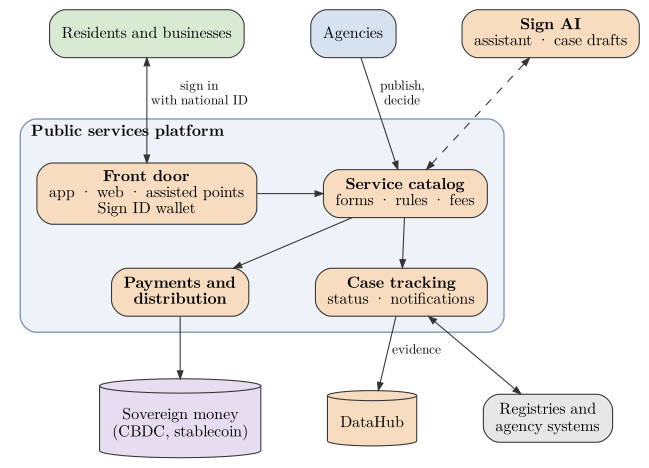
The platform has four parts (Figure 10). The front door is a mobile app and a website, with assisted service points for people who need help in person, and the Sign ID wallet sits inside the app, as Digital Identity and Credentials recommends. The service catalog holds each service as a configurable workflow: its forms, eligibility rules, required credentials and documents, fees, approval steps, and deadlines. Case tracking gives every application a status, an owner, and a history that the applicant can see, and notifications tell the applicant when something is needed. Payments and distribution collect fees and pay benefits in sovereign money or through banks. Around these parts, agencies publish and run their services through an administration console, and connectors reach the registries and case systems they already operate.
Because services share these parts, most of the work of launching a new service is configuration: an agency defines its form, rules, and approval steps, and identity, payments, evidence, and AI assistance come with the platform. Through open interfaces, banks, telecom operators, and other enterprises can offer their own services to verified users under the government’s rules.
Services on the Platform
Six services show how the shared parts combine. Business incorporation and benefit distribution are described in more detail below.
-
Business Incorporation: A founder starts and runs a company from one account, from the first description of the business to a registered company with a Business Pass and a compliance calendar.
-
Benefit and Asset Distribution: Benefits, subsidies, pensions, and other government assets reach verified recipients.
-
Licenses and Permits: Applications, renewals, and changes run as cases, and the resulting license is issued as a verifiable credential that supervisors and counterparties can check.
-
Certificates and Records: Birth, residence, education, and other certificates are issued as credentials that the holder can reuse with any verifier.
-
Taxes and Fees: Sign AI prepares claims and returns from the resident’s own records with their consent, and fees and taxes are paid in the same app.
-
Travel and Residence: Visa and residence applications run as cases, the applicant’s ePassport chip is read to verify identity, and the visa is issued as a verifiable credential.
Business Incorporation, Benefit and Asset Distribution, Real-Time Supervision, Sovereign AI Infrastructure, and e-Visa Issuance cover these services in more detail.
Business Incorporation
For an investor, registering a company is often the first real contact with a country, and in many places it means separate visits to a registry, a notary, a tax office, and a bank, each asking for the same documents. Our incorporation service turns that into one account on the platform, from the first question about eligibility to the company’s filings years later. It is designed first for special economic zones: each zone adopts its own legally approved requirements, and every official decision stays with the authority that holds it. We have built an interactive prototype of the service for a special economic zone.
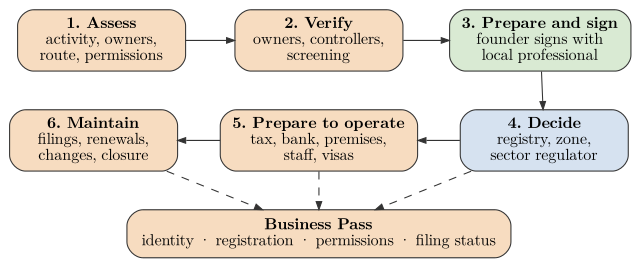
The journey has six stages (Figure 11). The founder first describes what the business will do, since the activity decides which legal forms, routes, and permissions apply, and the service recommends a route and lists what is missing. The owners are then verified down to the individuals who ultimately control the company and screened against sanctions lists and for politically exposed persons. Where founders hold identity credentials, the platform checks them directly instead of collecting copies of passports. A local professional prepares the documents, the founder signs them electronically where the law allows, and an authorized filer submits them to the registry, the zone authority, and any sector regulator, whose questions the founder answers in the same case. After approval, the service coordinates tax registration, bank accounts, premises, staff, and visas, and the account stays open for filings, renewals, changes, and eventual closure.
Each company receives a Business Pass, a reusable record of its identity, registration, permissions, and filing status, issued as verifiable credentials that banks and counterparties can check without contacting the registry. The pass keeps submitted, accepted, registered, and licensed as separate statuses, because only the authority’s decision sets a legal status. Once the company operates, the pass also drives a compliance calendar in which every filing and renewal has an owner, a due date, and a receipt, and overdue items go to a named case manager.
The platform manages the cases and keeps the evidence under the authority’s control. Local professionals give the legal advice and make the filings that the law reserves to them, authorities approve, refuse, or attach conditions, each bank makes its own decision, and directors remain responsible for their company. Where one operator serves both applicants and the authority, separate teams keep the decision independent, and a refusal records its reasons and the route to appeal. A regulated business, such as a payment firm, goes to specialist review, because a legal form grants no financial-services permission, and its licensing follows Real-Time Supervision. Significant steps are recorded on the DataHub, and Sign AI explains requirements in the founder’s language.
Our direction is to start with one zone, one company form, and a limited set of activities, and to launch only once local counsel and the authorities have approved the requirements. Digital Free Zones shows how incorporation fits a digital free zone. We measure it by complete and timely filings, not by the number of approvals.
Benefit and Asset Distribution
Distribution is the service that pays benefits, subsidies, and other government assets to citizens and businesses. It runs on either of the money layer’s ledgers, at the throughput the chosen ledger provides, and pays programs in batches or on schedules.
Paying Many Recipients at Once
One distribution service handles every program and supports:
-
Batch Distributions: One approved list pays a large recipient group in batched transactions.
-
Scheduled Distributions: Recurring payments such as pensions and regular subsidies.
-
Multi-Asset Support: Any tokenized asset can be distributed, including national digital currencies and benefit tokens.
Paying the Right People
The distribution service checks identity credentials and Sign Protocol attestations against each program’s approved rules:
-
Verified Recipients: Distributions reach only verified, eligible recipients.
-
Attribute-Based Targeting: Distributions can be targeted by specific identity attributes (age, location, status, etc.).
-
Duplicate Prevention: Each payment is tied to one verified recipient’s credential, so the same person cannot claim or be paid twice under one program.
Distribution also widens financial inclusion. Where a recipient holds a national digital identity, eligibility and onboarding are simpler, and the government can pay the recipient’s CBDC wallet or stablecoin account directly, including people who were previously underbanked. Banks and payment providers still onboard their customers under their own KYC rules (Digital Currency & Stablecoin Infrastructure).
Which Ledger Pays
Distribution works across both blockchain infrastructures of the SIGN Stack:
-
CBDC Distribution: Privacy-preserving distributions on Sign CBDC for sensitive financial assistance programs.
-
Stablecoin Distribution: Transparent distributions on the public blockchain for programs that need it, with recipients identified on the chain only by pseudonymous addresses and program totals published openly. Because an address can still be linked to a person, we recommend this path where recipients may lawfully be public, and the CBDC path for individual benefits.
-
Cross-Chain Coordination: Program officials see one view of each program’s payments on both ledgers.
-
Payment Method Selection: Governments choose the distribution method according to privacy requirements and policy objectives.
Rules Attached to Payments
Program money carries its purpose (Table 3):
-
Staged Release: Time-based release of funds for long-term benefits.
-
Combined Conditions: Eligibility rules that combine several conditions.
-
Usage Restrictions: Spending limited to approved merchant categories or uses, through marked tokens.
-
Geographic Constraints: Use restricted to specific regions or localities.
Programs and Records
Distribution programs include:
-
Social Benefits: Distribution of welfare payments, unemployment benefits, and similar payments.
-
Pension Systems: Regular distribution of pension payments to eligible residents.
-
Emergency Aid: Rapid distribution of emergency funds during crises.
-
Agricultural Subsidies: Targeted support for farmers and agricultural businesses.
-
Education Stipends: Distribution of educational support payments.
-
Healthcare Benefits: Payment of healthcare subsidies.
-
Privacy-Sensitive Payments: CBDC distributions for support programs requiring confidentiality.
-
Cross-Border Assistance: International aid can reach recipients through the cross-border routes of Bridging and Interoperability.
-
Financial Inclusion Programs: Funding of CBDC wallets that banks and payment providers open for previously unbanked people.
Every distribution is recorded on the ledger. Dashboards show progress against each program’s allocated budget, reconciliation runs automatically, and aggregate statistics can be published so that the public can see where program money went.
Direction: One Front Door
Our direction is for the platform to become the government’s single front door, with every service a resident or business needs available in one place, in their language, at any hour. Services would also become proactive: when a birth is registered, the family would be offered child benefits and health enrollment without applying, and a new company would receive its tax and social insurance registrations without separate applications. Over time, agencies would publish services much as developers publish apps, on shared rails and under shared rules.