One Stack, Four Building Blocks
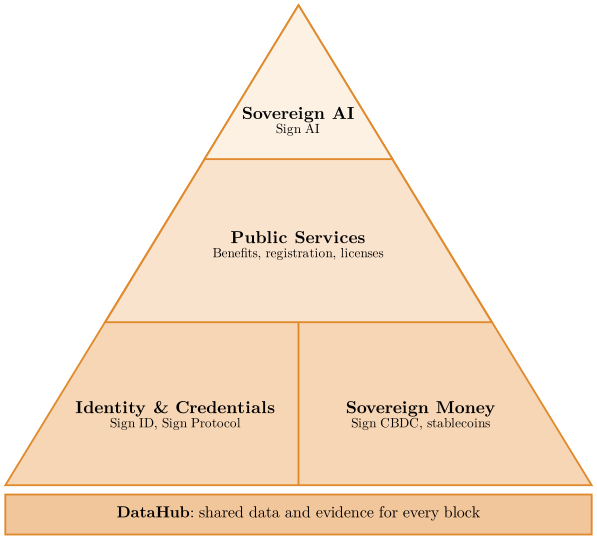
The SIGN Stack is sovereign Digital Public Infrastructure for a software-defined government (Figure 1). Its three DPI rails are Sign ID for identity, sovereign money for payments, and Sign DataHub for data exchange. The stack adds two things the AI era needs, a public services platform and AI under government control. It is built from four building blocks, each with its own ledgers, registries, or platform. Identity and money form the foundation, public services are built on them, and AI sits at the top, working across every service. The four building blocks are:
-
Digital Identity and Credentials: Issuers such as the civil registry sign credentials into residents’ wallets, and a shared trust registry tells every verifier who may issue what. Sign ID carries the national identity, and Sign Protocol records the facts a ledger must check. Verify once, trusted everywhere.
-
Digital Currency & Stablecoin Infrastructure: The government chooses the path for each program. Sovereign smart contracts on a public Layer 1 carry money that should be visible, such as regulated stablecoins. Sign CBDC, built on Hyperledger Fabric-X and Panurus (formerly the Hyperledger Fabric Token SDK), keeps payments private while every payment passes the central bank’s policy gate. A bridge that only the central bank controls, or conversion through regulated stablecoins, connects the two, as Bridging and Interoperability describes.
-
Public Services Platform: Agencies publish each service once as a configurable workflow, with its forms, rules, fees, and approvals, instead of building separate portals. Benefits, business registration, licenses, and certificates all run on it, and residents reach every one from a single app or website.
-
Sovereign AI Infrastructure: National compute and approved models, with Sign AI as the control layer. Every AI task runs under set permissions, cites approved sources, and ends with an official’s decision on record, and sensitive work stays in the country.
Sign DataHub is the base that all four blocks stand on, not a fifth block: departments share standardized data through it, every exchange leaves evidence, and Sign AI reads government data only through it (Shared Data and Evidence Layer). Together, these components let a government deliver its services on infrastructure it controls and under its own rules. Real-Time Supervision shows how regulators use the same components to supervise the digital economy that runs on them.
These choices follow the principles funders apply to any DPI program. The stack uses open standards such as W3C Verifiable Credentials and ISO 20022, and its ledgers build on open-source projects, so it connects to existing systems and to other countries. Residents share only what a service needs, and the DataHub records the purpose of every access to government data. Assisted service points and AI that answers in local languages reach people without a smartphone or a bank account. Every agency reuses the same layers, officials make every decision that affects a person’s rights, and after handover the government can run the system itself or appoint another operator.