Real-Time Supervision
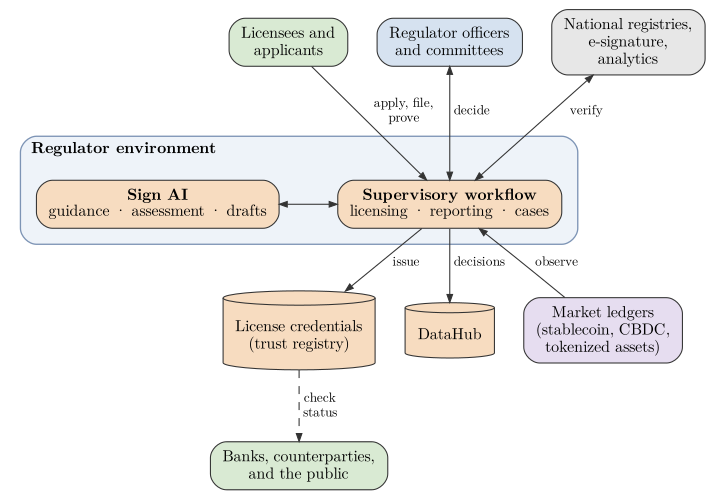
As identity, money, services, and assets move onto digital infrastructure, supervision has to move with them. Most regulators still work from periodic filings, paper or PDF licenses, and spreadsheets, and they learn about problems weeks after they occur. The SIGN Stack puts the regulator on the same rails as the market it supervises (Figure 15).
Supervision on the Market’s Own Rails
-
Licenses as Credentials: A license is issued as a Verifiable Credential bound to the licensee’s verified identity. Its status, whether active, suspended, or revoked, is published through the trust registry, and its lifecycle is anchored to the DataHub. Banks, exchanges, counterparties, and the public can check a license without contacting the regulator, and a revocation reaches every verifier within the time policy sets (Table 10).
-
Supervision from the Ledger: Where regulated activity runs on sovereign ledgers, the supervisor can read it directly through views limited to what it is authorized to see: stablecoin supply and redemptions, tokenized-asset issuance and transfer restrictions, and CBDC activity within the limits of its privacy model. Supervision shifts from periodic filings toward continuous, verifiable data.
-
Proof of Compliance: Licensees prove facts with attestations, using zero-knowledge proofs where disclosure must stay limited. Examples are reserve confirmations, capital confirmations from their banks, and compliance with the Travel Rule, which requires sender and recipient information to accompany a virtual asset transfer.
-
Evidence for Every Decision: Recommendations, approvals, committee votes, information requests, and sanctions are signed and recorded, so that a court or auditor can verify how each decision was made.
-
Shared Supervision: Agencies retrieve approved records and verified license status through controlled interfaces, and credentials give a path to the recognition of licenses across borders.
Example: Supervising Virtual Asset Firms
Virtual asset service providers (VASPs) are a natural first domain, because their activity is already on-chain and regulators are building their supervisory capacity now. Our reference platform for VASP licensing and supervision is designed to cover the full regulatory cycle.
Applicants apply through accounts linked to their organization. Identity, company, ownership, and beneficial-owner information is checked against national registries and approved external services, together with sanctions and politically exposed person screening. Each decision needs either a second official’s approval or a recorded committee vote, and is signed with the state electronic-signature service. Reminders and deadlines never grant, refuse, or revoke a license on their own. An approved application creates the license record, and a public registry publishes only approved fields. The company registry and the licensing authority each record their result on the DataHub as it happens, including any later suspension or renewal, so a bank opening an account for the VASP checks a proof of both without contacting either, and an earlier decision stays traceable after a suspension.
After licensing, VASPs file periodic returns that the platform validates, and exceptions become supervisory cases with assigned officers, evidence, deadlines, and signed information requests. Licensees declare their wallets with signed proof of control. Daily on-chain activity is reconciled against filed returns, and a licensed blockchain analytics provider screens declared wallets and their counterparties, with alerts linked to cases inside the platform. Travel Rule records keep licensee-reported status, external-service results, and officer conclusions apart. For suspicious transaction reports, the platform holds only restricted metadata and never the report contents.
Sign AI supports the people on both sides. Applicants and officers get answers from regulator-approved material with cited sources. Document assessment flags missing items and conflicting statements, such as inconsistent descriptions of custody arrangements, and officer assistance drafts case summaries, risk observations, and correspondence. The AI never approves applications, changes licenses, determines violations, or sends official communications.
A first release can run as a conventional workflow platform connected to national registries, signature services, and analytics providers, so a regulator can license and supervise from the first day. License credentials, ledger anchoring, and direct supervision from sovereign ledgers would be added as the market moves onto sovereign infrastructure. The same pattern extends to stablecoin issuers, tokenized-asset issuers and custodians, and other regulated sectors.