Bridging and Interoperability
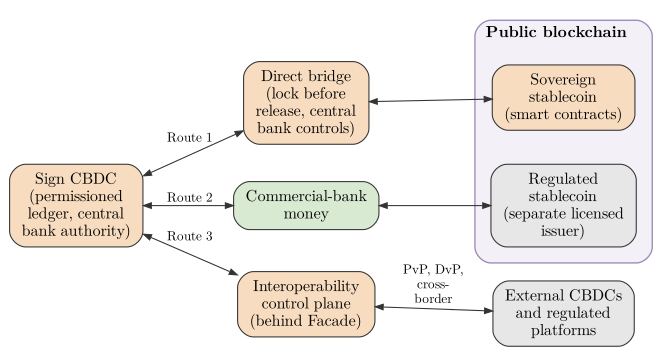
Sovereign money has to reach other systems, including public-chain stablecoins, other central banks, and regulated platforms, without the central bank losing control of its own ledger. Our reference design provides three routes, and a central bank selects those that match its legal mandate and risk appetite (Figure 9).
Direct CBDC-Stablecoin Bridge
The SIGN Stack design includes a bridge that converts value in both directions between Sign CBDC and the national stablecoin on the public path. Where a licensed issuer issues the stablecoin, it also operates the bridge: the CBDC it receives is locked in escrow on the CBDC ledger and backs the stablecoin it mints, and the reverse happens on return. Users move CBDC to stablecoin for access to public-chain services, and stablecoin back to CBDC for privacy-sensitive payments. Each conversion locks value on one side before releasing it on the other, so the same value cannot circulate on both ledgers at once. The stablecoin in circulation never exceeds the CBDC held in escrow. On the return leg the stablecoin is burned and the escrowed CBDC is released, so no CBDC is minted, and the release waits until the burn is final on the public chain. The bridge is designed to reconcile escrowed and circulating totals continuously and report them to the central bank. The central bank sets the conversion terms and the individual and aggregate conversion limits, AML and counter-terrorist financing checks apply to every conversion, and the central bank can suspend bridge operations when necessary.
Indirect Conversion through Regulated Stablecoins
Where a central bank prefers that its currency never leave the permissioned ledger, public-chain access is indirect. Users convert CBDC into commercial-bank money, and commercial-bank money into a regulated national-currency stablecoin issued on a public chain by a separate licensed issuer, with the reverse sequence for return. Each leg settles and reconciles in its own system, the stablecoin is not a claim on the central bank, and no public-chain event can trigger an operation on the CBDC ledger. Public-chain liquidity becomes reachable while public-chain keys, data, and finality stay outside the central bank’s platform.
Links to Other Central Banks and Regulated Platforms
For connections with other central banks and regulated platforms, an interoperability control plane behind the Facade hosts adapters for other CBDC platforms, multi-CBDC arrangements, wholesale and cross-border payment platforms, and tokenized-asset platforms. It supports cross-border CBDC payments, payment-versus-payment and delivery-versus-payment settlement, cross-currency settlement under foreign-exchange policy, liquidity transfers, and reconciliation across platforms.
Each platform executes its own leg under its own authority, a principle shared by BIS Innovation Hub experiments in cross-border CBDC. In Project Icebreaker, a retail CBDC never leaves its domestic system and a central hub only routes payment messages (source), and the Project Agorá prototype uses a layered architecture in which each central bank keeps autonomy over its national currency and operations within a shared platform (source). The control plane coordinates readiness and finality evidence from both sides and never writes to another ledger. For payment versus payment, each leg is designed to be locked on its own ledger and released only on proof that the other leg has settled, with an expiry that returns both if it does not. Settlement is reported only when the finality conditions of the approved profile are met, and incomplete or contradictory evidence goes to a governed pending or dispute process. Every connection is activated through an approved integration profile that defines its corridor, participants, data, compliance screening, and settlement rules.