The Public Path: Sovereign Smart Contracts on a Public Layer 1
Deployment Model
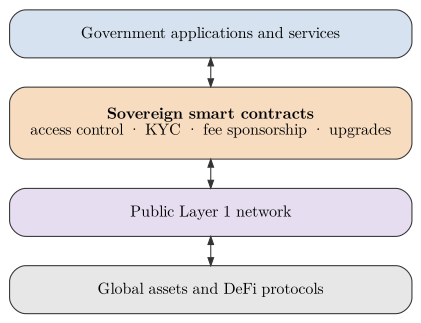
On the public path, a government deploys its stablecoin, tokenized assets, and public records as upgradeable smart contracts on an established public Layer 1 network such as Ethereum. The government governs the contracts, and the host network’s validator set provides security and finality, so a transaction cannot be reversed once the host network finalizes it (Figure 6). This path provides:
-
Operational sovereignty with the security guarantees of an established network
-
Government-set rules on who may hold, send, and receive each asset
-
Upgrades and parameter changes approved only by authorized government keyholders
-
A foundation for national digital assets, registries, and services
-
Access to global liquidity, within the transfer and conversion rules the authorities set
Customizable Parameters and Governance
Governments can customize the infrastructure in the following ways:
-
Access Control: Contract-level role-based permissions and address whitelisting or blacklisting for regulatory compliance.
-
KYC Enforcement: Identity verification requirements enforced through smart contract logic.
With these options, governments can fit the infrastructure to their own regulatory frameworks without giving up the security of the host network. The appendix gives the technical specifications.
Operational Control
Governments have operational control over the infrastructure in the following areas.
Transaction Fee Policy
The government decides who pays network fees. It can sponsor fees for every user or only for approved addresses, such as citizens and service providers, through contract-level logic or by submitting transactions on users’ behalf (meta-transactions), so citizens do not need to hold the network’s native token.
Protocol Governance
Every change to the contracts goes through controls the government holds:
-
Governance Control: Every change needs the approval of several authorized government keyholders through multi-signature wallets.
-
Parameters and Upgrades: Authorized entities adjust parameters and upgrade contracts through upgradeable contract designs, known as proxy patterns.
-
Emergency Controls: Authorized government keyholders can respond to a security incident, including by pausing the contracts.
Security Model
The contracts inherit the security of the host network’s validator set and consensus mechanism, so no independent consensus infrastructure is required. Contracts are independently audited before deployment, and the government keeps operational control through the governance mechanisms above.
Global Financial Access
Assets issued on sovereign smart contracts, such as stablecoins in the standard Ethereum token format, ERC-20, and tokenized real-world assets, can be bridged to and traded against other global assets, such as the main dollar and euro stablecoins and ether, Ethereum’s native currency, within the transfer rules each asset carries. A transfer of a registry-backed asset is submitted to the registry for recording, and the registry’s record prevails, as Real-World Asset Tokenization explains. On the private path, public-chain access runs through the bridging routes of Bridging and Interoperability.
What the Public Path Is For
The public path suits programs whose activity the government wants to be visible:
-
National Stablecoin: Issuance and management of a national-currency stablecoin under the government’s rules (Who Issues the Stablecoin).
-
Asset Tokenization: Registry-backed tokens for land titles and other national assets, with the national registry remaining the legal source of title (Real-World Asset Tokenization).
-
Public Spending: Grants and other programs whose totals the government publishes, paid through the distribution service (Benefit and Asset Distribution).
-
Public Records: Verifiable public status for records such as licenses and permits.
Who Issues the Stablecoin
A national-currency stablecoin is usually issued by a licensed issuer, such as a regulated bank or payment institution, under rules that the central bank or financial regulator sets, rather than by the central bank itself. The most widely used dollar stablecoins follow this model, issued by private companies rather than central banks, and it keeps the stablecoin a claim on its issuer, not on the central bank. We are flexible on the model: the platform supports a licensed private issuer, a state-owned issuer, or the central bank where its mandate allows. Whichever the government chooses, its rules set what reserves back each token and how they are reported, who may redeem and on what terms, and how residents and non-residents may acquire and convert it. The central bank decides whether the token moves only between allowlisted holders or trades openly on public markets. With an allowlist, the contracts enforce residency rules and holding caps on every transfer; with open trading, the platform is designed to enforce conversion limits and residency rules at the bridge and at regulated on-ramps only. International guidance, such as the Financial Stability Board’s recommendations for global stablecoin arrangements (source) and the CPMI-IOSCO guidance on applying the Principles for Financial Market Infrastructures to stablecoin arrangements (source), gives a reference for writing these rules.