Where Sign Protocol Is Used
Sign Protocol attestations can serve the following government services.
Identity
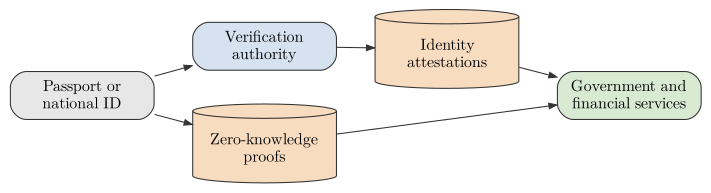
Sign Protocol supports a globally verifiable, privacy-preserving digital identity system for access to government services. Residents register with existing credentials, such as passports or national IDs, and receive digital identity attestations that complement the physical card.
A citizen’s verified credential becomes the way they sign in to digital services, and benefits and service access can rely on it. Personal data stays with the holder and the issuer, and the ledger holds only attestations and proofs. The approach includes:
-
Resident Onboarding: Residents present existing government identification (passport, national ID, etc.) to authorized verification entities who create cryptographic attestations of identity verification.
-
Digital Access: Verified identity attestations can serve as sign-in credentials across government and financial services.
-
Global Interoperability: Authorized verifiers in countries that recognize the issuing state’s trust registry can check an attestation against published keys and status, without a separate integration with each issuer.
-
Integration with Existing Systems: Compatibility with ePassports that follow the international standard (ICAO 9303), NFC reading of the passport chip, and biometric verification systems.
Credentials
Qualifications and credentials can be issued and checked as attestations:
-
Educational Credentials: Verification of degrees, diplomas, and certifications.
-
Professional Licenses: Attestations of professional qualifications and licenses.
-
Training Certifications: Verification of completed training programs.
-
Public Service Eligibility: Attestations of eligibility for specific government roles.
Property Rights
Ownership can be attested from the registry that holds it:
-
Land Ownership: Attestations of title and boundaries issued from the land registry, which remains the legal record of title.
-
Vehicle Registration: Verification of vehicle ownership and registration.
-
Intellectual Property: Attestations of patents, trademarks, and copyrights.
-
Digital Asset Ownership: Attestations of ownership recorded in the authoritative registry.
Regulatory Records
Registries and regulators can attest to their own records:
-
Business Registrations: Attestations of business registration and good standing.
-
Regulatory Approvals: Attestations that a regulatory approval has been granted and remains in force.
-
Audit Certifications: Attestations of completed audits and inspections.
-
Import/Export Authorizations: Attestations of international trade approvals.
Voting
An election has to prove two things that pull against each other: that every ballot came from an eligible voter, and that no ballot can be traced back to the person who cast it. Sign Protocol is designed to support digital voting that proves both. An eligibility credential issued from the electoral roll lets a voter cast a ballot without revealing who they are. Ballots are recorded cryptographically, zero-knowledge proofs show that the count is correct without revealing any ballot, and anyone can verify the result once the count is published.
-
Eligibility without Exposure: The voter proves eligibility with a credential, so the tally never sees an identity and the electoral roll never sees a ballot.
-
One Person, One Vote: A tag that is unique to each voter in each election, and cannot be linked across elections, prevents double voting without linking a ballot to its voter.
-
Verifiable Results: Each voter can confirm that their ballot was included, and anyone can check that the published tally matches the recorded ballots, without compromising ballot secrecy.
-
Accessibility: Overseas citizens and people with mobility limitations can vote remotely, in a design intended to limit coercion, for example by letting a voter recast a ballot, and assisted voting points serve people without a smartphone.
-
Cost Savings: Counting would be automated, and much of the physical ballot infrastructure and manual counting would no longer be needed.
A government can phase adoption by the stakes, starting where the law already allows electronic voting and the cost of an error is low, such as public consultations, participatory budgets, and elections in universities, professional bodies, and state-owned companies, and extending to binding referendums and elections only after independent security evaluation, with an audit trail that does not depend on the voting software, and where the law allows them. The same tools support new forms of participation (What Governments Can Build).
Border Control
With Sign Protocol, governments can manage customs and border security jointly through encrypted watchlists while each keeps sovereignty over its national data. States share only cryptographic commitments to watchlist entries, never the personal data behind them. The design lets a border officer scan a passport and learn whether the holder is flagged, without either country disclosing its list. Every match goes to a border officer for a decision, under a bilateral agreement that sets the listing criteria and gives travellers a way to challenge a flag. The system has several advantages:
-
Data Sovereignty: Sensitive national data stays under domestic control while countries cooperate internationally.
-
Privacy Protection: Cryptographic techniques keep personal information from being exposed during verification.
-
Security: Checks against partner states’ watchlists would run in real time without sharing the underlying records.
-
Operational Efficiency: Instant verification reduces processing delays and improves the border crossing experience.
e-Visa Issuance
Sign Protocol attestations support electronic visa processing for immigration services. Applicants apply online, and their identity is verified through zero-knowledge proofs from the ePassport chip. Each processing step is recorded as an attestation, which keeps the workflow transparent and reduces opportunities for fraud or corruption. Capabilities include:
-
Automated Processing: Routine processing steps run automatically and reduce administrative overhead.
-
Identity Verification: Identities are verified securely with existing passport infrastructure and on-chain attestations.
-
Transparency: Immutable processing records support accountability and reduce processing disputes.
-
User Experience: Visas are issued faster, and applicants receive status updates in real time.
-
Fraud Prevention: Cryptographic verification reduces document forgery and identity fraud.